Monday, August 07, 2017

A new use for an old building

St John's Church on Town Road in Hanley, the city centre of Stoke-on-Trent, has been empty and unused for as long as we have lived in the Potteries which is twenty years this year.

This interesting church is now wedged between the two halves of the Intu Potteries Shopping Centre and was crying out for someone to care for it.  It was bought a few years ago and the idea was to turn it into a restaurant but that fell through and it has recently been bought and refurbished.  A  few weeks ago it opened as the 6 Towns Antique and Vintage Emporium and Elsie's Tea Room.

Having never seen inside the church we decided to pay a visit last Friday. After spending half the morning at doctors, vets and opticians - the vet's bill was far more than that of the optician - we were in need of coffee and cake.

 The tea room is placed near the side entrance to the church, the staff are very friendly and helpful and the coffee and bananna and chocolate cake was delicious.

 There was a general buzz about the place, a few people had come in for coffee, some just to look at the antiques and a few more like me to look at the interior and specifically the windows and monuments.
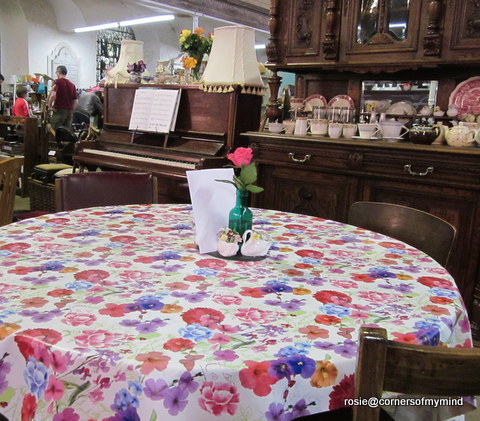
The piano is there for anyone who can play and apparently someone played for a couple of hours one afternoon when there was a party in for afternoon tea.  He'd only popped in to have a look and ended up spending most of the afternoon there.  I can see why.

According to the notes on the menu for Elsie's Tea Room the church was built in 1792 and replaced another church which had been on the same site from 1738.  Apparently a stone was found from the earlier church during excavations. 

The windows were fascinating.

As were some of the monuments on the walls.  The one above is to commemorate the life of Samuel Alcock of Cobridge who 'for a period of twenty years joined with the congregation of this church in the sacred offices of public worship'  He died 10th November 1848 aged 49 years and 'was singularly kind and charitable in disposition' and 'upright and liberal in all his dealings'  The members of the church paid for the memorial.


Apparently the window above is quite unique in that it is the only known stained glass window dedicated to a solider who was killed during the Anglo Zulu wars of 1879.  The solider was Pte William Henry Hickin of the 24th foot who fell at Isandhlwana in South Africa on 22 January 1879 aged 25.  He was born in Hanley in 1854, the son of Henry and Hannah Hickin.  On the 1871 census the family lived on High Street,  William's occupation then was a writing clerk.  His father Henry's occupation was locksmith and bell hanger.

Above is a memorial to the memory of Ephraim Chatterley of Shelton who 'in humble reliance on the mediation of his redeemer exhchanged this life for a better' on 7th day of May 1811 aged 66.  According to the inscription he had a 'zealous and stedfast (sic) attachment to his native place.'

The East Window of painted, rather than stained, glass c. 1830

The upper galleries where the vintage sales areas are to be placed later on.
  
In one of the articles I read about the church it was described as having been built when 'ecclesiastical architecture was at its lowest ebb' and was 'a brick built edifice of a debased style of Gothic'.  The church is also noteworthy because of its early use and cast iron in both structural and decorative work including the gallery columns.


The window above is dedicated to the memory of Abraham Dutton who was the parish clerk of the church for fifty five years.  He died on 10th October 1883 aged 80 years.  On the 1881 Census Abraham Dutton was living at 28 High Street and was recorded as a widower and his occupation as watch and clock maker.

Above is part of a stained glass window which is a memorial to some of those from the area who lost their lives during the First World War.

Thursday, August 03, 2017

Summer?

When I looked out of the bedroom window this morning it looked like a dull, windy, autumnal day.  I have washing drying around the house as every time I try to hang it out it seems to start drizzling.

We have loads of fruit on the plum tree but it just needs few dry, warm and sunny days to ripen.

Over the weekend in the midst of all showers I made a Summer Pudding.  

 It was very tasty served with Swedish Glace which is our favourite non dairy ice cream. Of course we like dairy ice cream too.

It made our evening meal on Saturday seem very colourful


especially alongside the quiche and salad which made us feel summery even if the weather outside told a different tale.

The rain seems to clear away in the late evenings and this has meant visits from the urban foxes.  These are the three cubs.  They are old enough now to come on their own although mother fox is usually around somewhere not too far away.


The garden is looking very pink at the moment with late summer flowers.  Hydrangeas, Roses, Japanese Anemones, Valerian and Hebe.

The Internet problem I mentioned in my previous post seems to have sorted itself after a phone call or two and a bit of messing with the laptop.  Hopefully it's back to normal now.

Edit Sunday 6th August.  I have made a separate page (link at the top of the blog where the book lists are) for the Summer Pudding Recipe as one or two people have asked about it.

Friday, July 28, 2017

The Parish Church of St James, Bonsall, Derbyshire

As promised in my last but one post I'm returning to the lovely, historic village of Bonsall to take you inside the parish church.  I've saved this post until now especially for Church Tourism Week.  This is organised by The Churches Conservation Trust, although this isn't one of the churches in its care, I thought it was an apt time to record my visit.

After our lunch at The Fountain Tea shop (see my post on Bonsall Village)  we walked up to the church.  I hadn't expected it to be open but it was.  Unfortunately I'd left my bridge camera in the back of the car but I had my little Cannon Power Shot camera in my bag so I was able to take a few photos.

There wasn't a guide book or leaflet inside the church so I took photos of the things I'd noticed realising that I'd probably miss something important along the way.  I've since been 'googling' to find out more about the church and the various things I'd recorded.

The most obvious and fascinating aspect of the church was the difference of the floor height  between  the nave and chancel.  A few steps up from Nave to Chancel are expected but in this church there are seven.  The bottom and top ones are thinner than the others.

From reading various blogs and reports it seems that the level of the  nave floor was dropped in the 14th century and this may explain the extra steps up into the Chancel and the rather large column bases in the nave.  This has given the church the honour of being known to have what is possibly the highest Chancel in the country.
 
On the base of one of the columns is a strange carving which some sources say might have been underground until the floor level was dropped.  It is known locally as the Bonsall Imp or the Little Devil although it has also been described as a cross between a frog and a unicorn.  .

I can see from the one horn on the head and the webbed looking feet where this idea of the image came from.

 At the top of the North aisle a modern glass mobile hangs in front of the window reflecting the colours of the stained glass.

There were some interesting wall monuments to the great and good of the village.  The large one oval one on the wall is a memorial to a man called Henry Ferne who died in 1723 having served as Receiver General of the Customs during the reigns King William III, Queen Anne and King George I.

The font is probably from the late 12th or early 13th century.

The unusual stone above is in the South aisle and is a bull baiting stone.  It was brought into the church by a former Rector who was so upset by the idea of bull baiting that he had the stone removed from the market place into the church.  Animal baiting was finally made unlawful twenty years later in 1835.

Above is one of the two Medieval stone grave  slabs that stand either side of the alter in the South aisle, not far from the bull baiting stone.  The other was behind a banner and couldn't be photographed easily although it was thicker and slightly more elaborate than this one.  They were moved out of the church during the restoration of 1863 and ended up in a churchwarden's garden.


The churchyard was full of both wild and garden flowers which look lovely against the grey weather worn stones.

I'm experiencing great difficulty with internet speed at the moment and we are not sure what the problem is.  I can count to twenty or sometimes even thirty before getting on line then the time to move between sites is about the same, reading and commenting on blogs takes ages as pages keep jumping about and scrolling up and down takes ages as the screen seems to freeze.  It has taken me two or three days to complete this post so I may have to take a break for a while until the problem is solved.

Monday, July 24, 2017

Dinosaurs of China - Part Two

I covered part one of our visit to this exhibition in my Five on Friday post on 7th July - link here.  The main part of this exhibition is at Wollaton Hall in Nottingham but there is a second smaller exhibition at the Djanogly Centre which is part of Lakeside Arts on the University Campus.  We had booked tickets to hear a talk given by Pterosaur expert  Dr Mark Witton of Portsmouth University.  It was a free lunchtime talk called 'Not your Father's Pterosaurs: How Scientists are Reinterpreting Mesozoic Flying Reptiles' although it sounds rather specialist and dry and given that I'm not the Pterosaur expert of the two of us I actually found it quite fascinating and Mark Witton an excellent and engaging speaker.

We set out from home to drive to Beeston where we parked and caught the tram to the University.  The journey only took about ten minutes and I was able to use my bus pass by just registering it at a little swipe machine.  

  
The trams in Nottingham are each dedicated to a famous person from or who has deep connections with the County of Nottinghamshire.  Thus you will spot passing by trams with such names as  Brian Clough, D H Lawrence, Lord Byron, Torvil and Dean, Jesse Boot, William Booth, Alan Sillitoe, Ada Lovelace and many more not forgetting Robin Hood of course.  I didn't notice which tram we travelled down to the University on but we came back on Vicky McClure and spotted Rebecca Adlington going the opposite way at the tram stop.


The exhibition was in the smaller gallery at the Djanogly Centre.  We had a good look around.

Plenty of space to sit and wander around in this part of the exhibition which concentrated on Palaeo-art or bringing Dinosaurs to life.  It looked at the ways artist and scientists have illustrated and depicted the remains they have found.

Alxasaurus a feathered vegetarian descended from meat eaters.  Early Cretaceous it was found in Inner Mongolia, norther China. and could grow up to about 4 metres long.

Dilophosaurus sinensis - has hollow bones like birds.  A carnivore it is from the Early Jurassic and was found in Yunnan Province in China. Size 4 metres long or the size of a mini car.
After looking at this exhibition we moved on to the main Summer exhibition at the centre.  In complete contrast this exhibition was entitled Kaleidoscope: Colour and Sequence in 1960s British Art.   

Photos were not allowed in many areas of this exhibition so I've included a photo from the 'What's On' leaflet I picked up.  It was a fascinating display of bold shapes and bright colours.

After coffee and what was labelled a date and walnut scone but which after slicing in half and buttering appeared to contain only apricots we strolled out to the lake and walked a little way along the lakeside path watching new graduates with their proud families having their photos taken with the lake as a backdrop. 

It was time to take our seats in the small theatre at the back of the Lakeside building pictured below.
The talk started with screen shots of how artists and film directors had depicted Pterosaurs in the past and how different today's thoughts on both appearance and lifestyle had changed.  The talk lasted about 40 minutes and there were lots of questions afterwards.

We emerged from the cool dark theatre into hot, bright sunshine and made our way back to the nearby tram stop to catch a tram back to Beeston where we picked up our very hot car and began what proved to be a very uncomfortable and sticky drive home.

Thursday, July 20, 2017

The village of Bonsall in Derbyshire

The pretty village of Bonsall lies on and around a hill just off the Via Gellia (the A5012) which runs from Cromford until it meets the A515 Buxton to Ashbourne road. Various sources say that the Via Gellia was probably named for or by Phillip Eyre Gell who had the road built through the valley around 1790 so that he could move lead from his lead mines down to a new smelting works at Cromford.  Other sources say that the road was there much earlier in the 1720s and was used as a route for transporting stone from the Gell family's quarries at nearby Hopton.  The area was noted for its cotton mills and the name of Viyella fabric (a mixture of wool and cotton) is said to come from from the Via Gellia valley.

Anyway, back to the historic former lead mining village of Bonsall.   We parked near the Cascades Gardens and wandered through the recreation ground to our first port of call.


Priorities right and first things first - lunch! 

At the Fountain Tea Rooms which is
opposite the village fountain.  The Fountain also provides B&B accommodation.

  The fountain is Victorian Gothic in design  and was restored by the Parish Council in 1993.

After lunch we took a steep climb up the public footpath to the parish church which sits high on its hill overlooking the village.

The Parish Church of St James was built in the 13th century in a
prominent position over looking the village. Much of the exterior  was rebuilt in 1862.  Inside it has what is thought to be the highest chancel in the country as there are seven steps up to the chancel from the nave.  Hiding in the church is also what is known as the 'Bonsall Imp'.  We'll explore inside in a later post.


The Market Cross is a Grade II listed building and is thought to date from the 17th century although some parts could be earlier.  It apparently has 13 steps, I didn't count them.  The ball on top was added in 1671 about the time the village asked to be allowed a market charter but their application was never granted.

One of the village wells.  The village holds a 'well dressing' festival and carnival at the end of July.

A framework knitters cottage at the start of the Limestone Way.

The 'T'owd Man of Bonsall' is thought to depict a lead miner and it is also probably one of the earliest ever illustrations of a miner.  The original carving was in the village church but it is now found embedded in the wall at St Mary's Wirkswirth  (link to my post on St Mary's Church - here)
Another view of the Market Cross with the 17th century King's Head pub behind it.

We had come to the village to visit the Cascades gardens and nursery.  This a a four acre garden in the centre of the village which takes advantage of the natural landscape. Like The Fountain it also has B&B accommodation.

I'll share more about the garden in a later post.