Monday, April 11, 2016

Weekend Wanderings

The weather has been rather lovely this weekend and we spent some time in the sadly neglected garden.  I did a bit of weeding in the front garden and some of the grass has been cut but half of it is still too wet to work on. There is such a lot to do and we are still chopping and bagging up the last branches of the tree that was taken down at the front of the house a few weeks ago. More from the garden in a later post.

We have managed a couple of trips out locally in the last couple of days so below are some photos I took whilst out and about.


We had a walk at Froghall Wharf down the lane and through the woods.

 It was wet and muddy underfoot, thank goodness we had wellies on

 Just look at all that wild garlic, this wood if full of it and the smell when it is in flower is amazing.

We then walked  along the canal towards the steam railway

and went onto the platform of the  Kingsley and Froghall station.

 We didn't see a steam train as we were there about 11a.m. and it wasn't due in from Cheddleton until after midday.

We walked across the line to look at the new picnic area and small nature reserve being created at the station.

It was lovely to see so many wildflowers and shrubs as we walked.

The next day we went to Ashbourne in Derbyshire and had a wander around. Above are just a few photos I took in the centre in the little lanes around the Market Place.

Saturday, April 09, 2016

St Bartholomew's Church, Tong

After our visit to Boscobel House we moved on just a couple of miles down the country lanes to the village of Tong so we could take a  look at the rather impressive church we'd seen many times from the main road on our way to the RAF Cosford Museum at Albrighton.


The present church is a fine example of Perpendicular Gothic Architecture and was built as part of Tong College founded by Lady Isabel de Pembrugge.  She was granted a license to build the college in 1409 and the buildings which housed priests and clerks stood to the south of the church.  To the west there were thirteen almshouses to house thirteen paupers seven of whom had to be 'weak and worn in strength' and unable to look after themselves without assistance.

Let's have a look outside in the churchyard first.

Ruins at the west end of the church were part of the collegiate buildings and were possibly the alms houses.


The old preaching cross on the South side of the church 

The grave of Little Nell which is just outside the south door of the church isn't a proper grave.  Apparently Charles Dickens set the final chapters of The Old Curiosity Shop in Tong and an enterprising verger created the grave as it was of interest to visitors and he found it quite a lucrative occupation to guide them to the grave.

Above is the aspect you see of the church from the main road, is there any wonder we wanted to explore a bit more?

The church is amazing inside, below are some of the highlights.

The view from the nave of the chancel, choir and sanctuary

The ceiling of the Golden Chapel which was built by Sir Henry Vernon in 1510.

Above the tomb of Richard Vernon (d. 1517) and his wife Margaret Dymmok who was the daughter of Sir Robert Dymmock, the King's Champion at the coronations of Richard III, Henry VII and Henry VIII.  Richard Vernon is one of the Vernons of Haddon Hall in Derbyshire.  Their son Sir George Vernon who was known as 'King of the Peak' was buried in Bakewell church.  Here is a - link to a post I wrote in August 2013 about the Vernon tombs in Bakewell Church.

In the photo above taken in the sanctuary the piscina and sedilia both dated 1410.

Above the tomb of Sir Richard Vernon (d.1451) and his wife Benedicta de Ludlow.

In the foreground the tomb of Sir Henry Vernon (d. 1515) and his wife Dame Ann Talbot (d 1494) beyond is the tomb of Sir Thomas Stanley (d. 1576) second son of the third Earl of Derby and one time Governor of the Isle of Man and his wife Margaret Vernon who was the daughter of Sir George Vernon of Haddon mentioned above.

Stone carvings above the Vernon tombs in the Golden Chapel

The 'Door of Excommunication' in the North aisle is a former doorway blocked in possibly during the Civil War on it is a fragment of an old tomb which is old enough to have come from the earlier church building. 

 There was a castle at Tong of which remains now sit under the nearby M54.  Above is an image of it carved in stone in the church porch.  Here is a -link-to more about its history.

I hope you have enjoyed this short visit to a fascinating building.

Friday, April 08, 2016

Five on Friday

It's Friday so I'm joining in with  Amy at Love Made my Home for this week's Five on Friday.  Click on the link at the bottom of this post to find others who are joining in too.

Five small things that have made me smile this week

 1.  Busy thrushes - we've seen both of them for the last few days picking up moss and vegetation for their nest which seems to be in the laurel bush near our side gate.

 2.  Night skies and sunsets.  This one was on Wednesday evening when the golden light across the garden was stunning too.

 3.  Tulips - a bunch from the supermarket white with delicate purple stripes look so pretty when there is rain outside.

 4.  Photos taken with my little Canon camera at Bridgemere Gardens between showers on Thursday morning.  I was pleased with the misty magnolia above and the arch, topiary and reflections below.  


and last but not least.......

5. Watching a good film - a friend recently loaned us a copy of Michael Palin's film American Friends.  I rember seeing it when it first came out about twenty five years ago but short of remembering it was set mostly in Oxford about Fellows of the college not being allowed to marry, I'd forgotten the gist of the story and who apart from Michael Palin was in the cast.  Needless to say I really enjoyed seeing the film again as it is so well made, with beautiful settings and based on a true story about Michael Palin's great grandfather.

All for now.  Have a lovely weekend everyone.
 

Monday, April 04, 2016

Boscobel House

We have just renewed our membership to English Heritage and Bocobel House was our first visit of the new season to one of their properties.  We had visited quite  a few years ago when we first moved over to this side of the country and thought it was about time we went back.

Boscobel is one of the two houses on the borders of Staffordshire and Shropshire to be associated with the escape of Charles II after the Battle of Worcester in 1651.  You may remember that we visited the other house Moseley Old Hall, a National Trust property, in June last year - here is a link to the post I wrote then so you can, if you wish, see the two places together.

The property has had many different uses over the years.  It was built in 1632 on land formerly belonging to Whiteladies Priory as a farmhouse and later it was converted into a hunting lodge by its owner John Gifford.  At the time of the English Civil Wars Boscobel was owned by the Gifford family with the Penderel family living there as their tenants and servants.

The Giffords were a Roman Catholic family living at a time of religious persecution and it is thought that the real reason for the building of the house was to serve as a secret place of shelter for Catholics in times of need.

As you can see there is a lot of conservation work being carried out but the volunteer we spoke to as we wandered around inside the house told us that it would soon be completed and the scaffolding and covers would be taken down.
You can see part of the knot garden in the photo above.

Of course Boscobel is famous for its oak tree, known as the Royal Oak, as Charles II hid in the tree on his first night at Boscobel.   He also hid in the priest's hole inside the house. The tree the visitor sees today is a descendant of the original tree having been grown from an acorn from the first tree.


Above are some photos of the inside the old farmhouse.  In this part of the house the light was a bit too dull to take many good photographs and, of course, no flash was allowed.  Bottom left you can see the priest's hole where Charles II hid whilst at Boscobel.  Most of the interior is panelled in dark wood and furnished as it would have been in Victorian times.  This links in with Victorian farm buildings and kitchens also on the site. 

There was a dairy and a scullery, with displays on the making and storing of butter and cheese.
Above the barn and stables and some of the residents of the buildings and farm yard. 


The Boscobel estate eventually came into the ownership of the Fitzherbert family of Norbury Hall in Derbyshire who let it to tenants including the Penderels.  It was sold to Walter Evans a Derbyshire industrialist in 1812 and it was the Evans family who restored the hall and perpetuated the story of Charles II in their own, unique way.  Boscobel was sold in 1918 to the Earl of Bradford who placed it and the tree in the care of the Ministry of Works which later became English Heritage.

Friday, April 01, 2016

Five on Friday

It's Friday so I'm joining in with  Amy at Love Made my Home for this week's Five on Friday.  Click on the link at the bottom of this post to find others who are joining in too.

First I want to say a quick thank you for all your lovely comments on my last two posts about walks in the Manifold Valley.

Below are five random happenings since we last met for Five on Friday.  

1.  Easter happened, the clocks sprang forward, we had sunshine for one day, a little bit of tidying in the garden was achieved and then Storm Katie appeared here in the UK. Chocolate eggs and hot cross buns were consumed.  I read a couple of books by two of my favourite authors over the last week because there seemed very little I wanted to watch on television.  Elly Griffiths's latest Ruth Galloway novel 'The Woman in Blue' and as it happens the story was set around Easter in Walsingham in Norfolk and was as good and readable as ever.  I then moved on to the latest Isobel Dalhousie novel by Alexander McCall Smith called 'The Novel Habits of Happiness' I always enjoy these gentle and thoughful books, which are set in Edinburgh.

2.  Walking - we walked in both the Manifold Valley (see my last two posts) and at Dimingsdale in North Staffordshire  where I took the photos above.
3.  Homemade food - we made a cauliflower and butternut squash curry and some coriander naan bread to go with it and it was very tasty.  It took longer to prepare and assemble the ingredients than it did to cook the dish and the bread was lighter far less salty than the naan bread bought from the supermarket.
4.  Pretty things - in the shop at Middleport Pottery.  We walked around the lake at Westport and then down the canal to the pottery.  Much had changed there.  The comfy sofas in the cafe where we liked to sit had gone and there is now a charge to enter the Visitor Centre.  The wares in the shop are just as lovely though and free to peek at and admire if not to buy.


5.  Birds and Animals - we've seen lots of wildlife on our ventures out and about.  Above sheep and lambs in the fields at Alstonefield, geese on Westport lake, a brown rat on the bird table at Westport Lake, cockerel and hens and a dove at Boscobel House in Shropshire where we were yesterday.  Boscobel will probably be the subject of my next post.

All for now.  Have a lovely weekend everyone.

Tuesday, March 29, 2016

A Walk to Thor's Cave

I mentioned in my last post on  Alstonefield that we had been on a long walk before we got to the village.  The walk was along the trail in the Manifold Valley where the Leek and Manifold Light Railway (1904 -34) used to run bringing tourists into the valley and to Thor's Cave. 

 We left the car in the parking area near Wetton Mill and walked along the track
 
 We could see the cave in the distance. 

The track follows the line of the dry river bed.  It's dry because the river flows underground at this point.
We were getting closer to the cave, the question was should we or shouldn't we try to make it all the way to the entrance?
 
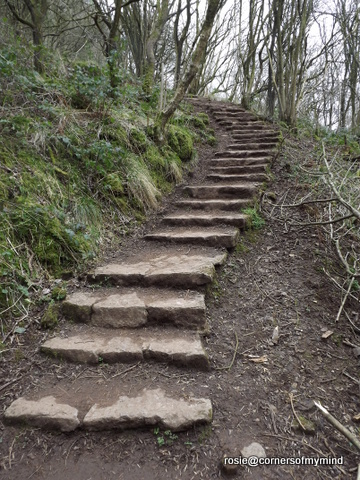
 The answer was yes, we would give it a try.  So up the stone steps we went, in defiance of ageing knees. The route curves up and round amongst the trees.

 Gently winding upwards, not a soul in sight, just the sound of woodpeckers beating out their rhythm on the trees.

 We saw some lovely wild flowers and plants along the way including wood anemone, dog's mercury and wild garlic.
 
 Onwards and upwards 
 
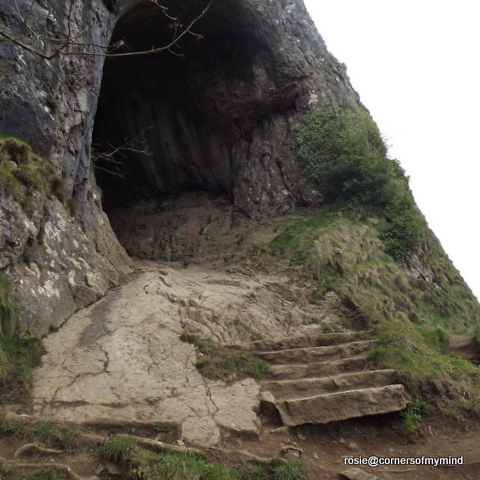
Until we got to the entrance.  We passed a group of walkers, three ladies with Nordic walking poles, on the way down and there were a couple of people and a dog just coming out of the cave as we arrived.

Next question - could I get inside?  It is about 10 years since I'd last been inside so I was determined to try.
A last look at the way we had come and then it was time to scrabble and scramble looking for hand and foot holds to get inside.

 We made it!
 
The next things was to take a few photos to prove it whilst trying not to worry about how I was going to get out, as you can see the rock was quite smooth and slippy underfoot.

 It was quiet, apart from the cawing of crows and jackdaws. 
 
 The cave was like a natural cathedral its walls soaring high up above.

The colours and textures in the limestone rock were wonderful.

 Excavations have shown that the cave was occupied from about 10,000 years ago and was probably occupied up to Saxon and Roman times making it one of the oldest sites of human activity in the Peak District.  Finds from the cave can be seen in museums around the district including Buxton Museum.


We walked back to the mill where we bought  delicious takeaway cheese and chutney sandwiches to go with the flask of coffee we had brought with us from home.  It was a lovely day, quite warm and spring like with no sign of Storm Katie waiting in the wings for the Easter weekend.