Showing posts with label meadows. Show all posts

Thursday, June 16, 2022

Meadow Flowers

Yesterday we took a short walk in the meadow at RSPB Coombes Valley.  The sun was warm on our backs, the birds sang as we made our way along the designated path.  Little black moths flittered around the grasses and bees were buzzing around the flowers.  It was a delightful half an hour.

I'm not very good at identifying all the different wildflowers but together they looked wonderful. 

Below are some of the flowers in the meadow.  I think I've identified them but I know there are people out there who know more than me so please tell me if I am wrong.
 
Oxeye Daisy.  It has lots of names like Dog Daisy, Moon Daisy and Moon Penny.

Butterfly Orchid

Common Spotted Orchid
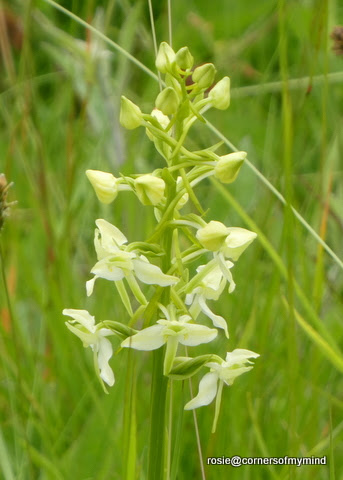
Butterfly Orchid

Ribwort Plantain

Birds Foot Trefoil also known as eggs and bacon or fingers and thumb.

Red Clover

One of the little black moths, I'd like to know what they are called.

The meadow is called Valley View.
 All for now.  Take care.
 

Saturday, May 03, 2008

Dents de Lion

Dandelions look so pretty in the meadows don't they, and in the hedgerows so why don't they look like that in my garden? Every year we have a running battle with them as they appear in the lawns, in the flower beds and then in pots and raised beds. They do say that a plant is a weed only if it is the wrong place. So these dandelions in my garden; are they weeds or just in the wrong place?


The word Dandelion may have originated from the medieval Latin Dents Lioness or the French Dent de Lion, lion's teeth. Some people say that the name comes from the jagged leaves, others from the long root. When I was a child we would blow the dandelion seeds or clocks and make a wish. The resulting little white fluffy seeds that floated delicately on the breeze we used to call fairies. Although we don't find the Dandelion useful in our gardens, unless we keep rabbits or guinea pigs, it does have it's uses both medicinal and culinary.


When you look at both the flowers and the 'clocks' they are very pretty but still we want to banish them from our gardens. I must admit I like to mow them off the lawn and take them out of the borders and flower beds but we do leave them at the back of the trees and allow them to stay put in the grass around the raised vegetable beds. The plants survive because they are hardly ever attacked by pest or diseases.


According to 'Jekka's Complete Herb Book' (Jekka McVicar 1994) medicinally Dandelions can be used as a remedy for kidney, liver and digestive problems, the leaves are a strong diuretic. The sap from the stalks can be rubbed into corns, warts or verrucas and the flowers can be boiled with sugar to make a cough mixture.

The leaves of the Dandelion can be used in salads and was often used for cleansing the blood as well as the digestive system, the leaves being quite high in certain vitamins. The root can be chopped, dried and roasted to make Dandelion Coffee and wine can be made with the flower heads. According to Mollie Harris in her book Country Wines (Alan Sutton Publishing 1991) the wine made with Dandelion flowers is a lovely golden colour and as well as being a tonic wine it can be used as a table wine too. She advises using flowers picked on a warm day and that St George's Day, 23rd April, is considered the best day to pick them if it isn't raining, but, she advises, never pick them from a dusty road side.


Perhaps we should give Dandelions a bit of a chance in our gardens instead of trying to wipe out every one? But, oh, no, I swear there are hundreds more in my lawn than were there yesterday - I'm off to get the mower out.