Friday, July 17, 2015

Five on Friday

Once again I'm joining in with  Amy at Love Made my Home for Five on Friday.  Click on the link at the bottom of this post to find others who are joining in too.

Five things in the garden this week

 1.   Fox - he's visited us before and no doubt he's been in our garden loads of times it's not very often we see him in daylight though.  Picture taken through our back bedroom window.

 2.  Newt - this is the first newt I've seen for ages in fact there were two of them under a plant that was being moved in the garden - one of them was warm enough to scuttle off but the other had to wait awhile to feel warm enough to move so I was able to catch a quick photo before it too scuttled off to find shelter.  This one is a male smooth newt because it has an orange stomach.


3.  Blackbird - we have lots of blackbirds in the garden and some of the more established ones sometimes have a grey patch on one of their wings but we'd never seen one with quite so much white on it.  It looks like it has a white collar.  It has visited the feeders a few times since I took this photo through the landing window.
 

4. Wood Pigeon - we have loads of them in and around the garden but this one amused me as he was sitting on the table outside the kitchen window waiting for the bird feed to go out first thing in the morning.  I took the photo through the window as I was washing the breakfast pots.

 
5.  Grey Squirrel - we have loads of these visit the garden too and they are emptying the bird feeders so quickly, they also bury small stones from the gravel path in the garden which seems a strange thing to do as they certainly aren't caching them away to eat later.  They are going to be very disappointed squirrels if they do come back thinking they've buried food.  Photo taken from the conservatory window.

If it wasn't for the photo of the newt I could also call this post five things I've photographed through windows this week.

Have a great weekend everyone.


Thursday, July 16, 2015

Bestwood Country Park

On Saturday we joined with friends from Beeston in Nottingham and others at a free event organised by the Nottinghamshire Local History Association.  The setting was the 690 acres Bestwood Country Park and in particular what remains of the former Bestwood Colliery.


We were taken on a guided tour of the Winding Engine House which was once the driving force of both the colliery and iron works at Bestwood.  Below you can see the Winding Engine House, headstocks and cage over the now fully capped down shaft.  The up-shaft has been demolished.

This vertical, twin-cylindered winding engine, built in 1876, is the only one of its kind left in Britain preserved thanks to a group of local people who banded together in the 1990s to save the winding engine for future generations.  Those of us with ancestors who were colliers, coal hewers and miners (and I have lots of those) as well as the odd tailor, saddler, cheese and butter maker, iron founder, ferrule maker, farmer, lace maker, dress maker and nail maker.  My grandfather was an ostler who went to work down the pit to look after the pit ponies and suffered from miner's lung in his later years.  When I saw the cage I thought about his father, my great grandfather who, in March 1907 was killed, not at this colliery but one on the Nottinghamshire/Derbyshire borders, when the cage he was travelling in broke and tipped and threw out three of the occupants.  He was one of them,  the survivors were left hanging in the cage until they were rescued. The empty cage at Bestwood was a chilling sight.  The colliery finally closed in 1967.


Inside the Engine house was quite amazing. The guide told us it is made with top quality materials with a fine and elaborate finish even in the timber roof.  The wheel now runs on electricity but the mechanism of the steam charged engine is still all there, in fact, as the guide told us, if they ever took it out the brick housing would collapse.  There is easy access to the ground floor and a modern glass lift to the floors above.  


The only other part of the old buildings still standing is the Dynamo House, a former electrical substation which now houses photographs and information about the history of the Bestwood Coal and Iron Company in its heyday as well as documents and artifacts.  Children can dress in period costume and the Friends of Bestwood Country Park and the Bestwood village WI provide refreshments on Saturday mornings between 10a.m. and 12 noon.


After lunch we went over to the opposite side of the Country Park to walk in the woods there.


Before Bestwood Park became a hot bed of industrial activity it was a Hunting Forest and part of the larger Royal Sherwood Forest.  It was popular with the local gentry and visiting monarchs who would come for hunting.  In medieval times there was a hunting lodge here and the area was enclosed with pale fences and ditches to become Bestwood Park.  My main interest in seeing this part of the park is its connection with Richard III for it was here in August 1485, where he had travelled from Nottingham Castle, his castle of 'care' to enjoy a few days hunting with friends when he heard that Henry Tudor had landed at Milford Haven and was making his way across country, he left Bestwood Lodge on 19th August to make his way towards Leicester and on 22nd August to his end on the battlefield of Bosworth. 


 The enclosed park remained in the hands of the crown and it was on a visit to here by Charles II and his mistress Nell Gwynne that he gifted the Lodge and park to Nell and their illegitimate son the 1st Earl of St Albans.  During Queen Victoria's reign the 10th Duke of St Albans made many changes to the estate.  These include the building of the new lodge, the building of the grand entrance at Alexandra Lodge and establishing the Bestwood Coal and Iron Company. He and his Duchess were also responsible for the creating of the colliery village and the housing of the colliery workers there.


The lodge is now an hotel and after our walk down to the Alexandra Lodge (above) we stopped there for a sit in the cool lounge with a pot of tea.

Above and below - photos of the present Bestwood Lodge

Inside the lounge was cool and airy

We sat in the cool leather chairs and drank our tea before walking back to the car park.


A lovely, companionable day out with friends with a history lesson or two along the way.

Friday, July 10, 2015

Five on Friday

Once again I'm joining in with  Amy at Love Made my Home for Five on Friday.  Click on the link at the bottom of this post to find others who are joining in too.

Five things that have kept me smiling this week

1.  Home made bread - Paul makes all our bread, this was quite a large batch most of which has been frozen for future use.  We ate one of the white batons with some home made ratatouille followed by.........

2.  Home grown strawberries - they took ages to get going this year but now we have loads.  I feel a summer pudding might be made soon.

3. Peak Wildlife Park - we visited a local wildlife park on Monday, it rained quite a bit but it was very interesting to see the animals and birds up close.  I fed and stroked a wallaby and had lemurs running around my feet.
 
4.  From the garden - the Pinks are in flower and I cut them for the house - this seems to encourage more growth too and they always look so pretty.


5.  In the garden - we have had a few times when we could sit out in the garden this week even though it has been quite windy - we had to take the gazebo down as it was in danger of blowing away.  In the photos some of the flowers blooming at the moment.  White Cosmos, red poppies, sweet peas, the verbena bonariensis we grew from seed and two types of hypericum Rose of Sharon and a hybrid which self seeded a few years ago and will take over the garden if we let it.  I think it is similar to St John's Wort.  Cats, of course, love the garden at this time of year, especially if they can pinch our chairs.

Have a lovely weekend everyone.


Wednesday, July 08, 2015

Pensthorpe Natural Park

It was raining the day we visited Pensthorpe and it just happened to be Paul's birthday too.  He particularly wanted to see the red squirrels here as well as the water birds and wild flower meadows.  This reminded me that we'd seen red squirrels in Scotland last year for his birthday  - link to post here.

We did eventually see a red squirrel at Pensthorpe

The last time we visited, must have been about twenty years ago it was called Pensthorpe Waterfowl Park. It has expanded and changed quite a lot since then.

 This covered viewing area was very useful in the pouring rain.

We ventured out and started to wander around the  Mill Pond and the other meres and lakes to see what we could find.  I fell for this little chap.

Crested Merganser

White-naped cranes with little one - just a day old when I took the photo

Tufted duck

Smew

These Eurasian cranes were very noisy.

These cranes made no noise at all

At this point we were making our way back to the shop and cafe as we were getting quite wet -  a coffee break was calling.
Back outside again we followed the bug walk and the wildflower meadow walk along by the river Wensum which runs through the park.

The wildflower meadows were full of damsel flies and the paths alive with little toadlets.  I showed photos of these on my 30 Days Wild blog - link here as I managed to continue the daily posts whilst away with limited access to the internet.

Below are some of the other beautiful birds we saw.....


Avocet

Little Stint


Turtle Doves - two turtle doves.  I didn't see a partridge in a pear tree though.

Not a bird but a fascinating sculpture in one of the gardens

Barnacle goose

Mandarin duck

My favourite geese - Greylags

So distinctive and such a beautiful shape.

Apologies for the number of photos.  I have loads more and there are some beautiful garden areas to explore too.  We spent nearly all day there.  Got wet through, dried out, got wet again and by the time we left the sun was shining. 

Monday, July 06, 2015

Castle Rising

The lovely village of Castle Rising in Norfolk is dominated by its castle.  This castle is one of my favourites and to me it is beautiful from every angle. It has got to be around thirty years since my last visit so it was great to see it again. We arrived at the free car park at 10a.m. just as the place was opening so we were able to spend the first half hour of our visit entirely alone in the building.

 Shall we go inside?

 This enclosed staircase is one of my favourite parts of the castle.  I love the sweep of the steps as you climb up to the entrance vestibule which used to lead to the great hall.

The original entrance arch to the great hall can still be seen but it was blocked up in the 16th century and a fireplace was constructed in the opening.

 Below a passageway cut through the thickness of the walls, again in the 16th century.  It leads to the kitchens and garderobes.


 The centre of the castle is roofless

Above is what remains of the great hall.  This was a grand public room where feasting took place and where the lord of the castle entertained his guests.

Next to the great hall is the great chamber where the lord of the castle would have slept and conducted his more private business.  Interestingly this room contained two garderobes both probably had doors but only one has a urinal as well as the usual construction.  According to the information panel this begs the question - does Castle Rising have the first known surviving example of separate facilities for men and women?

 Next to the Great Chamber is the chapel.  The castle was started in the year 1140 by a Norman Lord called William de Albini who had married Alice of Louvain, the widow of King Henry I. His influence in style came from the William Rufus keep in Norwich Castle.  It was completed by his son William de Albini II who transformed it to a grand and important residence.  In 1544 the Castle came into the hands of the Howard family as it was bequeathed to Thomas Howard, Duke of Norfolk by Henry VIII and it is still owned by descendants of this family.


The Upper Chamber was added in the early 14th century.  You will notice a fire grate from around 1800 in the room.  This was added when the castle was used as Rising's police station.  There is also a tale about this room from the 18th century.  It was used as a cell for a sea captain for his own safety after his experiences in naval warfare 'turned his mind' - I guess this would have been what we know as 'shell shock' or post traumatic stress disorder.


 We left the inside of the castle and walked around the earthworks.  You can view the gatehouse from here and also the castle from every angle.


Above are the ruins of a church c.1100 which was discovered in the 19th century having been covered by collapsed earth from the earthworks.  It is thought that this church was demolished when the castle was built.

Above is the later church, photo taken from the earthworks, which was built in the village

We walked into the village towards the church passing a lovely cafe with an outside garden and seating area on the way.  It is quite easy to get into the village from the other entrance to the castle which is on the village side.

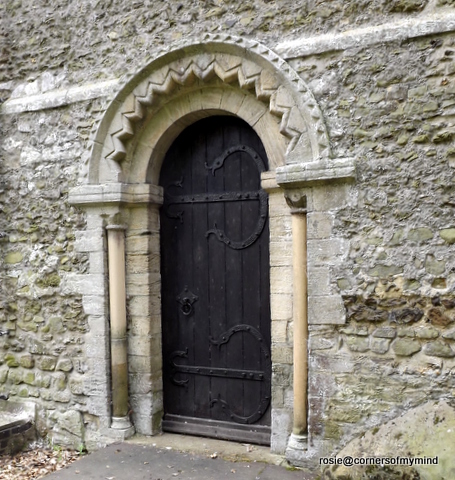
The parish church of St Lawrence was begun c1140, there are still many Norman features but as with many parish churches it has undergone extensive restoration during the 19th century.

We had a quick peek inside but I didn't take any photos as they were setting up flower arrangements for the flower festival and village fete to be held over the weekend and I didn't like to intrude.  The displays of wildflowers either side of the entrance porch were so pretty.

Below is the 15th century Market Cross beyond which is the site of the medieval market place, now a useful area for the tents and awnings being erected for the village Fete.

Below are some of the carvings and features found both inside and outside of the castle


One of the Castle's most well known and notorious residents was Queen Isabella wife of Edward II.  She was known as 'the she-wolf of France' and lived in the castle after the Edward's death.  She and her lover Roger Mortimer were implicated in his deposition and murder.  She was visited at the Castle on several occasions by her son Edward III.