It was so good to get out and about today after almost a week indoors suffering from a nasty cough and cold. I still don't feel that great but a bit of fresh air and exercise helped me to feel more myself so I'm hoping it is onwards and upwards from here.
I know I've written posts on Ilam before but I never tire of the place so I hope you don't either!
We had a walk along the river and back through the fields before heading down to the church.
Stopping to admire Ilam Hall on the way; it must be one of the most beautiful Youth Hostels in the country!
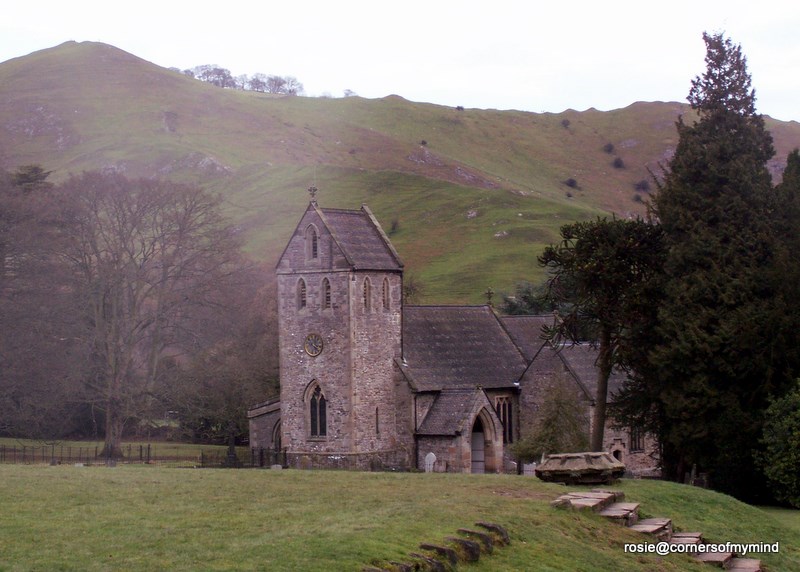
I love the way the church nestles in the landscape. This is the church of the Holy Cross and there was a Saxon church on the site before this one. You can see outlines of an old Saxon door in the wall near the entrance and some of the lower masonry is of Saxon origin.
Above is one of the two Saxon crosses that can be found in the churchyard; below is the outside of the mausoleum chapel added in 1831.
As the door was open we decided to have a quick look inside the church; the lights were off so the lighting levels were quite low for taking photographs. I did manage to take a few.
Above is the tomb of St Bertram who was, according to legend, a Mercian prince whose wife and baby were killed by wolves. He lived as a hermit near Stafford and then at Ilam. His remains were eventually moved to Stafford but the alter tomb, which dates from the 13th century, is still a place of pilgrimage and prayers are left here - you can see them on top of the tomb in the photo.
Close by St Bertram's tomb is the 17th century Alabaster tomb of Robert and Elizabeth Meverell of nearby
Throwley Hall, now an imposing ruin which I'd love to visit one day soon.
Above is a view of the chancel; I didn't realise until I got home and looked at the photos that the east wall was painted a bright blue.
In the photo above taken across the nave you can just see the font of 1120; the figures around it are thought to depict the life of St Bertram.