Saturday, February 01, 2020

A Bear Hunt and The Bee Tree

On Wednesday we took advantage of the morning sunshine and visited The Brampton in nearby Newcastle.

 We walked through the parkland and the sensory garden towards the museum.


Inside something was happening

Not in here - the wartime kitchen - where there is always something to spot that you recognise from childhood. 

A lot of these things were still around in grandparents' houses in the 1950s.

Upstairs in the street scenes something was afoot!

Something was distinctly out of place.

Why was Paddington Bear in an Edwardian doctor's surgery?
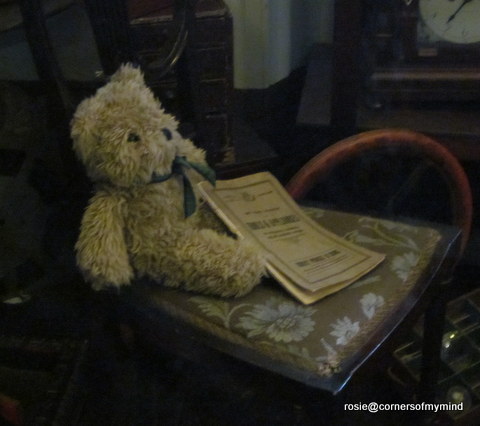
Why was this little fellow in the antiques shop when he doesn't look so very old?

Did Pooh Bear ever ride a rocking horse?  Perhaps he did.

 Oh, I see we were on a Bear Hunt!

Outside we found something new - The Bee Tree.  It was created by local artist Anthony Hammond.  Here is a -link- to his website.

Wood carvings in the trunk of an old tree

It shows the different aspects of the life of a bee.

Different stages of a developing hive

Plus below a Bee B&B where live bees could lodge.  

It was being used as some of the holes were covered in old leaves.

I assume the bee on the top is the Queen Bee.

The tree was also home to other things - Tinder Fungus.

As well as various kinds of fungus and mosses.


Meanwhile some things remained the same.  The statue of the 1914 -1918 VAD nurse based on a quote from Vera Brittain's 'Testament of Youth' - she lived just around the corner - is still sitting reading her letter from the front. Here is a - link - to a post I wrote about the statue in 2016.

Whilst nearby stands the silhouette of women in WW1, including Vera Brittain, hoping for 'No More War.'   Here is a - link - to more about it.


In the grass under the trees there were signs of spring.

It had been a lovely morning to be out and about seeing old things and discovering new ones.

Sunday, January 26, 2020

The RSPB's Big Garden Bird Watch

We started counting yesterday morning at around five minutes past ten.  Notebook and pen ready, cameras ready and warm mugs of coffee at hand as our conservatory can be quite cool in the mornings.


As usually happens when we sit down for the hour of bird counting the usual visitors don't appear.  Where were the wood pigeons, rock doves and collard doves?  

Total count over the hour was

Starlings - 16
Goldfinch - 9
 Sparrow-6
Chaffinch - 6 
 Blackbird - 4
Robins - 2
Blue Tit -2
Dunnock -1
Great Tit - 1
Coal Tit - 1
Wood Pigeon -1
Collard Dove - 1

Crows and Magpies flew overhead but didn't land and only one of the four collard doves that usually visit together in the morning decided to land for a while. We saw all four of them later in the day.

When you enter your results on the RSPB's website they also ask what other wildlife you see regularly in the garden.


Squirrels visit during the day and from our outside wildlife camera (a Christmas present from us to us) we know we get night time visits from foxes and badgers.

 Just behind the fox you can see a cat.


I think the badgers are one of the reasons we no longer get hedgehogs visiting.  When we first came here over twenty years ago we often used to see hedgehogs in the garden. 

There is still time to complete a count should you wish to join in.  Details below:-

RSPB Big Garden Bird Watch

Friday, January 24, 2020

On Friday

It's Friday! Shall we have a five?  Below are five things that have made me smile this week.

1. Tulips - a different colour combination to the last ones.

 2. Squirrels in the garden always make me smile.

3Spring flowers on a cold and frosty day

4. A new animal trail for children around the gardens at Trentham.

5Occasional, wintry, crisp and  frosty days
to make up for the foggy, dreary, damp days we've had more of recently.


Sunday, January 19, 2020

Carsington, Derbyshire

Yesterday morning dawned bright and sunny with just a little frost. We wanted to be out and about in the fresh air after being inside most of the week due to the seemingly endless rain. We decided to visit the village of Carsington in Derbyshire so we could take a walk and spot some wildlife but also buy suet nibbles for the garden birds.  We buy all our other bird food, sunflower hearts, meal worms and fat balls from Wilco, but prefer the nibbles from the RSPB. 

First task was to buy the suet pellets and take them back to the car.  


Sparrows feeding in the courtyard outside the RSPB shop.

Then it was time for a late breakfast/early elevenses at the cafe before setting out for a walk.

 Scarves, hats and gloves on we set out into brilliant almost blinding low winter sun.  Having said that I don't wear a hat unless I really have to, it has to be extremely cold although I do wear a sun hat in the summer.  I really don't like things on my head - hats scarves, hoods I find all of them irritating.

I always find this kind of light a challenge as I can never see what I'm taking photos of, I just aim, click and hope for the best.

 I did manage to take some photos as we wandered around by standing in the shade and looking out to the light.

 We took the path down to the Nature Centre which is a big hide and information centre combined with telescopes provided.

 We only saw one swan all the time we were there plus the one above!

There were lots of Lapwings or pee-wits as we used to call them as children.  They were all over the islands out in the reservoir, resting, feeding and preening.

 Many would take off at the same time and wheel around in the sky before returning to the edges of the water.

The mallards were all gathered under the bird feeders ready to hoover up seed dropped by the smaller birds.

 We moved on to the village of Carsington and parked by the village green where a family of badgers caught my eye.

Across the road was the small church of St Margaret's which looked wonderful in the sunshine and also looked as if it might be open to visitors.
It was!  

The church dates from the 13th century and was built in rectangular form with nave and chancel as one unit. There is early tracery in the East window.

The gallery at the west end of the church was installed in 1704 by Sir John Phillip Gell to accommodate the tennants of his estate at nearby Hopton Hall.
 
The font dates from the 14th Century.

The sundial dates from 1648

Back on the village green is the base of a Saxon Cross which was moved from the ground of nearby Hopton Hall.  We hope to visit Hopton Hall in February when they have wonderful displays of snowdrops.