Tuesday, July 06, 2010

A Step Back in Time - part 3

Are you still with me on our adventure? I do hope so! I promise this is the last post about Blists Hill!

The first stop when you enter the museum is the bank where you can change your money into old 'pound, shillings and pence' money to spend in the shops. When we arrived there were three school parties visiting and many of them were queuing at the bank so we decided to move on and go to the furthest point of the museum grounds first and work our way back towards the town.

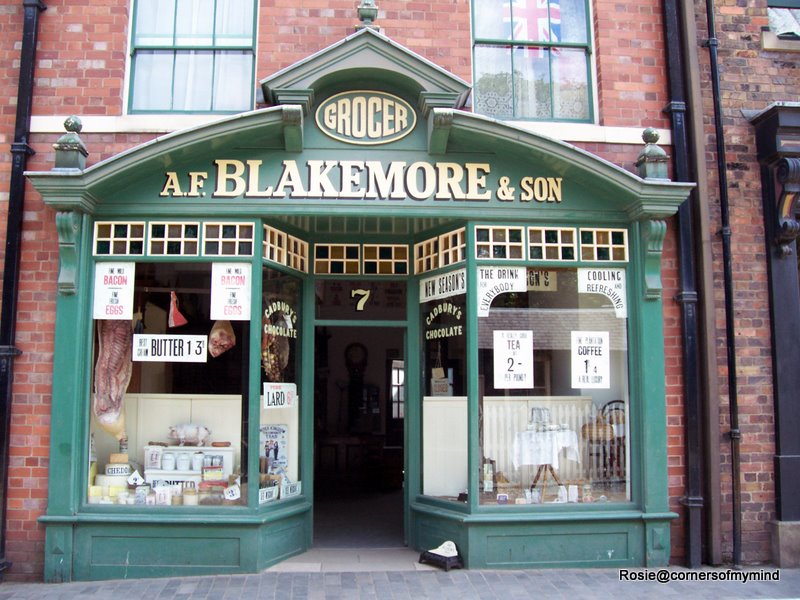
This was a good idea as when we got back to the town it was lunch time and the shops were empty and the on site cafes and picnic areas were full. Here are some more shop interiors.

The haberdashery shop where I bought a handkerchief for 'threepence three farthings'

The Post Office. Up above the post office is a small museum dedicated to postal delivery services - it was actually quite interesting with plenty of old photos and oral history stories to listen to.

The General Provisions Store.

The printer at work - well having his cuppa! 'Votes for Women' was one of the most popular posters.

In the doctor's house the housekeeper was drying rose petals picked from the garden and also herbs over the fireplace for use in medicines.

Above is the kitchen at the doctor's house.

Inside the house next door to the sweet shop.

These were the travelling actors who gave a performance; the horse is called Casey.

Above a few more scenes around the museum - I hope you've enjoyed your visit!

Friday, July 02, 2010

A Step Back in Time - part 2

We were, as some of you knew, at Blists Hill Victorian Town near Ironbridge in Shropshire. We had a lovely day on Monday wandering around the town. It is some years since our last visit and there was lots more to see and do this time. I don't remember these cottage gardens from last time; the lady in the lovely working/field sun bonnet was picking peas or beans.

We walked along the canal side as far as the Hay Inclined Plane which connects the canal at Blists Hill with the Coalport canal. The tug boats coming from the mines and foundries at Blists Hill would be lowered on the plane to the Coalport canal which eventually connected with the River Severn so that goods could be exported all over the country and beyond.

The remains of the blast furnaces from the old foundries were still in place and the town has been built up around them.

Then it was down the main street, past the doctor's house, of which more later, where we found the fairground on the green, opposite the school.

Inside the school there was a class taking place and all the children were learning their 2 times table by rote - one two is two, two twos are four, three twos are six and etc. No photos allowed whilst the class was taking place - the building is the old Stirchley Board School.

Down past the clay mine where later we had a ride on a railway into a 'mine' to watch a short shadow display about a father and son caught in the mine after an explosion caused by fire damp. We were encourage by those trapped to move swiftly back up the tunnel to the waiting fresh air. We moved on to one of my favourite buildings on the site - Squatter Cottage.


The lady inside told us all about the family who had built the cottage in the 1840s and who lived and worked there. Apparently according to the 1851 census there were eight in the family, and only one bedroom in the cottage. The members of staff who interpret the site are wonderful; some are animateurs who stay in character and period no matter what questions are thrown at them. Others dress in costume but communicate as in the present and explain what life would have been like towards the end of the 19th century.


Just around the corner from Squatter Cottage is the Shelton Tollhouse.

Here the toll keeper explained about the building of the toll roads especially the one served by this tollhouse which ran up to Holyhead so that politicians and businessmen, who had complained bitterly about the state of the roads, could reach the coast and sail to Ireland more easily. The family who lived in this house would have been better off working class with a steady income even so the house came with the job and wouldn't be owned by the tollkeeper.

Whilst waiting for passing carts and carriages she was knitting balaclavas for troops in the Transvaal. Below are some more photos of the toll house.

As we still have to visit the doctor's house, watch some outdoor theatre, visit the post office, the bank and look at some privvies and pig sties, if you can bear with me a little longer I will come back soon with part three!

Tuesday, June 29, 2010

A Step back in Time

Yesterday we took a walk not just in another place but in another time. Would you like to come along with me now to see what I saw yesterday? I hope you will enjoy your visit here as much as I did!

First we'll stroll by the park.......

Where the portrait artist is at work - no it isn't Monsieur Monet but it looks a bit like him!


We can do a bit of window shopping

There's plenty to look at

We can walk on the shady side of the street, out of the midday sun

If it gets too warm we can take a ride to see the rest of the town - there's a lot more to see

in my next post!

Saturday, June 26, 2010

Simple Pleasures

Here are some of the things that have pleased me today

Fresh flowers from the garden

Pretty foxgloves seen on our morning's walk

At last! A goldfinch tries out our new nyger seed feeder

New cat on the block - don't know to whom it belongs to but it really likes pond dipping!

The first gooseberries - gooseberry crumble anyone?


Healthy courgettes growing in the raised beds - this means tasty courgette bake or ratatouille for lunch or tea!

Thursday, June 24, 2010

Favourite Places

I've been mooching around in this warm weather; getting up early and getting jobs done before it gets too hot to do anything. Whilst the worker is marking exams on line - very tedious and soul destroying apparently - I've been thinking about the seaside and about some of my favourite places to visit. A couple of those places are Staithes and Saltburn-on-Sea on the North Yorkshire coast. I much prefer Saltburn and Staithes to Whitby and Robin Hood's Bay - not that I don't like those places too - I love climbing the 199 steps in Whitby to the Abbey on the cliff top and meandering down the little streets to the shore at Robin Hood's Bay - but I think it is because they are less crowded, less commercial and still have the feel of what they were originally - a fishing port in the case of Staithes and a purpose built seaside town in the case of Saltburn. We have a print of Staithes on the wall close to the computer and I've just been looking out some photographs to share with you. Below is a little novella set in Whitby - I quite enjoyed it but not entirely my cup of tea - a bit spooky perhaps - but then that fits in with Whitby!


We last visited both places during a rainy August in 2004 so it is high time for another visit. Here are some photos of Saltburn taken then - I'm sure it won't have changed too much; a different shop or two perhaps!

The headland and pier

Down on the beach

there is a lift down to the sea front

The pier from the upper town.

Saltburn Town Centre - I've just been looking at the clock - we must have taken this photo at ten minutes to eleven on Wednesday 11th August 2004!

Staithes
Small print of Staithes from a painting by David Curtis, R.S.M.A., R.O.I (link) - I gaze at this scene often whilst I'm day dreaming! Below is our photo of a similar view - you can see how murky and wet it was.

Amongst the photos on my sidebar is one taken on the harbour at Staithes of the Crab and Lobster Inn.

Staithes has historic connections with Captain James Cook (link) which I find fascinating.

Saturday, June 19, 2010

A Morning Stroll

Yesterday we were going to visit my sister and brother-in-law at Chesterfield. As we seem to be waking up earlier and earlier on these light and birdsong filled mornings we set off quite early on our journey. We drove out of the city towards Cellarhead, Froghall,Ipstones and through Hartington, Monyash and Bakewell finally parking at Baslow. At nine-thirty in the morning there was just us plus a few ladies all locking their cars and heading to the village hall with rolled mats and blankets under their arms. A yoga class perhaps?

We headed towards the entrance to Chatsworth park. The weather was a little grey and quite cool with just a glimmer of sun now and again. Just right for walking though. The stone cottages were looking particularly lovely in the early morning light; their gardens full of pretty flowers and roses or clematis around their doors.

I love these little thatched cottages at the side of the river.

As we ventured along the path towards Chatsworth House there was a sudden rush of newly shorn sheep - hundreds of them all careering towards us in a long line then suddenly veering off across the grass towards the top corner of the estate.

They viewed us with a slight interest but seemed intent on moving on as quickly as possible.

We could see the house in the distance. It was now 10a.m. and cars and coaches were beginning to arrive at the entrance all, I expect, anticipating a wonderful day out.

We spotted this lovely seat where we could sit and drink the morning coffee we had brought with us in a flask. I must admit it was cool enough to feel ready for its warmth.

Another look at the house - it looks as if there is some repair or conservation work going on - I imagine that there is always something to be done either inside or outside a never ending upkeep on such a wonderful huge building.

We were intrigued by this smaller building known as Queen Mary's bower. Apparently during the mid to late 16th century when Sir William Cavendish and his wife Bess of Hardwick were having the first house built a water garden was made between the house and the river containing a number of ponds and canals. The bower is thought to have been a viewing platform so that people could view both the house and the grounds. The balustrade was added in 1581 and it is said that it might have been used as a contained exercise area for the captive Mary, Queen of Scots who was held five times at Chatsworth from 1570 to 1581., hence its modern name. In the 18th century the water garden was filled in and the present park created by Lancelot 'Capability' Brown.

The view from the top along the river was amazing!

It was time to return to the car and make our way out of Baslow and up by the Robin Hood Inn towards Cutthorpe and on to Chesterfield. We had a lovely visit; after lunch at the garden centre, a good natter and look around, hanging baskets were purchased and put in place, it was soon time to head towards home returning along the same route we had taken earlier in the morning.