We decided to visit the deserted medieval village of Wharram Percy on our journey home. We'd highlighted three places on the map that we would like to visit on our journey in and out to the Yorkshire coast. They were the Norman Manor House at Burton Agnes, featured in a previous post, the Giant Monolith at Rudston and Wharram Percy. We'd visited the Norman Manor House so there were just the other two to tick off the list. We packed our bags and loaded the car for the journey home before having a last walk along the beach and through the town.
It was a very misty, murky day and visibility wasn't great but we decided to head out towards to the village of Rudston and then on to the deserted village anyway.
The monolith stands in the churchyard in the village of Rudston and at 25ft high is apparently the tallest monolith in the UK.Apparently it is capped in lead because at some point the top piece broke off - it used to be 28ft high.

In the 18th century Sir William Strickland carried out extensive experiments which concluded that there was just as much of the stone underground as there is above ground. This doesn't ring true somehow but many skulls were found during excavations and imprints of dinosaur feet on the megalith would suggest that it was always a site of great ceremonial importance and of worship - hence the church being built on the site in the 12th century.
Then it was on to find the deserted medieval village of Wharram Percy. I'd heard about this place over the years but had never visited. It was still very damp and murky as we set out along the path towards the site. The walk is about three quarters of a mile and not too bad underfoot although there are slippy slopes in places. It passes over the Wolds Way about two thirds of the way along.
As we crossed a small stile and bridge and walked towards the sign above many walkers and dog walkers were using the Wolds Way path.
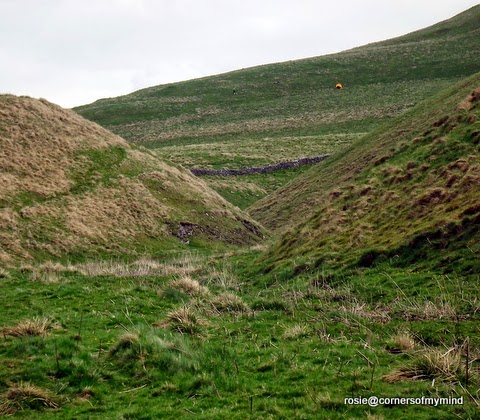
As you approach the village you can see the lumps and bumps in the ground up the bank side. Unfortunately a farmer was re-seeding the land up above for cattle feed so we couldn't go up and look down on the scene. The photo above shows the remains 18th century 'improvement' farm built by landowner Sir Charles Buck.
A few stone and brick cottages were built for the farm workers and the outlines of the remains of both the cottages and farm house can be seen alongside the remaining building which is the former byre and feed store. These were turned into small cottages to house the archaeologists who worked on the extensive excavations of the medieval village which took place over 40 years from 1950 to 1990.
The drawing above shows what the village may have looked like in the 13th century. Contrary to general belief it wasn't the Black Death which wiped out the village although there were considerable population losses at that time. The village survived until the late 15th century when much of the area was converted to sheep pasture. The final four families were evicted during the years 1488 to 1508.
The church of St Martin's was rebuilt in the 12th century, enlarged during the 13th and 14h centuries and then reduced in size during the late15th, early 16th century when the village was deserted.
The church continued to be used as a parish church by neighbouring villages. The gravestones in the churchyard date from the 18th and 19th centuries.
The mist was rolling and the rain was settling in so after we'd had a look inside the ruined church we turned back along the path back to the car park. I think I would like to visit again one day preferably on a guided visit so I can learn more and interpret what can be seen more easily because it is such a fascinating place.
Wharram Percy is on of the most intensely researched deserted villages in England in one of the most tranquil of places. It is hard to remember that this was once a busy and thriving community. It was easy to imagine that amongst the sounds of the birdsong, the farmer's tractor and the planes passing overhead I could hear the distant echoes of people as they went about their daily lives here.
In the 18th century Sir William Strickland carried out extensive experiments which concluded that there was just as much of the stone underground as there is above ground. This doesn't ring true somehow but many skulls were found during excavations and imprints of dinosaur feet on the megalith would suggest that it was always a site of great ceremonial importance and of worship - hence the church being built on the site in the 12th century.
Then it was on to find the deserted medieval village of Wharram Percy. I'd heard about this place over the years but had never visited. It was still very damp and murky as we set out along the path towards the site. The walk is about three quarters of a mile and not too bad underfoot although there are slippy slopes in places. It passes over the Wolds Way about two thirds of the way along.
As we crossed a small stile and bridge and walked towards the sign above many walkers and dog walkers were using the Wolds Way path.
As you approach the village you can see the lumps and bumps in the ground up the bank side. Unfortunately a farmer was re-seeding the land up above for cattle feed so we couldn't go up and look down on the scene. The photo above shows the remains 18th century 'improvement' farm built by landowner Sir Charles Buck.
The drawing above shows what the village may have looked like in the 13th century. Contrary to general belief it wasn't the Black Death which wiped out the village although there were considerable population losses at that time. The village survived until the late 15th century when much of the area was converted to sheep pasture. The final four families were evicted during the years 1488 to 1508.
The church of St Martin's was rebuilt in the 12th century, enlarged during the 13th and 14h centuries and then reduced in size during the late15th, early 16th century when the village was deserted.
The church continued to be used as a parish church by neighbouring villages. The gravestones in the churchyard date from the 18th and 19th centuries.
The mist was rolling and the rain was settling in so after we'd had a look inside the ruined church we turned back along the path back to the car park. I think I would like to visit again one day preferably on a guided visit so I can learn more and interpret what can be seen more easily because it is such a fascinating place.
Wharram Percy is on of the most intensely researched deserted villages in England in one of the most tranquil of places. It is hard to remember that this was once a busy and thriving community. It was easy to imagine that amongst the sounds of the birdsong, the farmer's tractor and the planes passing overhead I could hear the distant echoes of people as they went about their daily lives here.