Sunday, June 05, 2011

High Peak - Part Two

When we arrived in New Mills we parked close to the central station on station road near the river Goyt and walked along the riverside until we came to the Millennium Walkway.

As you walk along the path you pass the only surviving mill, the Torr Vale Mill, which has a wonderful position on the side of the river.  This mill held the record for the longest continuous textile production in the country having been a cotton mill for over 200 years when it closed in 2000.  A small part of the building still seems to be in some kind of use and there are plans for restoration.

The walkway  links the two parts of the Riverside park which now extends for two miles along the Goyt valley.  It is suspended on stilts and is attached to the retaining wall of the railway line which carries trains between Sheffield and Manchester.  It is also the final link of the Midshires Way a long distance footpath which runs between  Stockport and the Ridgeway * long distance walk in Buckinghamshire.


The views of the Torr Valley factory and the river are spectacular as you walk along with the trains passing by above.  You really get the feel here of the starts of the industrial revolution when the textile industry moved from being mainly home based to the new  factories placed so they could harness the power from the river water.

At the end of the walkway you find the ruins of Rock Valley Mill another of the mills built in the gorge where the Goyt and Sett rivers meet.  From here you can walk down to the start of the Sett Valley trail and another of the ruins of a former mill but we diverted up the steps towards the town centre and the Heritage centre.

The cobble stoned pathway gave rise to imaginings of all the mill workers making their way from the town to work at the mills; the sounds of the heavy shoes striking on the stones, their chattering voices the sounds of the mills working and of the other industries attached to them must have been tremendous. 

 Close to the top of the path, known as Rock Mill Lane,  and opposite the Heritage Centre is a viewing point over the valley of the tops of the factory buildings........

.......and of the railway line running above the walkway.

The Heritage Centre is very interesting and tells the story of New Mills as it grew around the mills in the valley and about the building of the railways across the gorge. It is free to go in and there is also an area for coffee and a lot of local tourist information too.
I was particularly taken with the model of the town below showing the working mills across the valleys of the Sett and Goyt rivers and the construction of  the Union road viaduct across the gorge.


Before return to the valley floor we had a walk around the town which, as well as covered and open markets,  has lots of little shops including a hardware shop, an old fashioned shoe shop with boxes up the walls, a wonderful second hand book shop and the place below which I spotted and have included a photo of as I know it will please one of my friends!

The national office of The Plain English Campaign.  I'm sure that they would probably find lots of faults with my babblings on this blog but then I've always been the master of the long sentence and it is very hard to change!

We wandered back down to the river valley to look at the viaducts,  the ruins of the Rock Vale Mill and the site of the new Torrs Hydro-Electricity Scheme so I'll  be back with part three of this visit.

* this walk runs from Avebury in Wiltshire and passes through Oxfordshire, Hertfordsshire and Berkshire on its way into Buckinghamshire.  The Midshires runs from Buckinghamshire through Northamptonshire, Leicestershire, Nottinghamshire, Derbyshire and Great Manchester - wouldn't it be amazing to have the energy, time and rescources to walk them both together?  What wonders you would see on your travels!

Thursday, June 02, 2011

High Peak - Part One

Late last week we decided to visit the town of New Mills to take another look at and photograph the Millennium Walkway.  We took a break at Chinley which is a lovely village just beyond Chapel-en-le-Frith.  As I took the photo below I turned and saw two goldfinches perched on the cow parsley in the lane; they were too quick for me to photograph  We have a pair visit our garden, in fact they are on the nyger seed feeder as I type this post but I only ever see them through the window so it was great to see them close to and out in the open.

Below is a photo of a little architectural gem the Chinley Independent Chapel, which is in fact just outside the village near the smaller hamlet of Chapel Milton.

It is one of the country's oldest non-conformist chapels and was built in 1711 but the group of dissenting worshipers who founded the chapel first started meeting in 1662,  led by the Rev William Bagshawe who was known as 'The Apostle of the Peak.'

Apparently it cost about £126, raised mostly by donations from sympathisers, to build and is two stories high. I peered through the windows and inside I could see galleried seating and box pews.  There was a huge central pulpit.  The two rows of windows let a lot of light into the interior.

In 1908 the chapel was almost completely renovated.  The walls were dismantled and rebuilt so the chapel looks the same as it did when first built.

The chapel will celebrate its 300th anniversary this year with a series of events to be held later this month.
Across the graveyard and cemetery is another architectural gem.   A bifurcating viaduct which carries two railways lines across the valley.


We'd passed under this viaduct many times on the main road on our way to Glossop or New Mills but had no idea there was an adjoining viaduct or that the delightful little building of the chapel was so close by.

When you actually stop to look instead of passing by it is the most amazing architectural feat.

Our next stop was New Mills,  a walk amongst the remains of the old  cotton factories in the Torr Valley and a visit to the Heritage Centre.  I'll tell you more in my next post.

Monday, May 30, 2011

Photo Scavenger Hunt - May 2011

Here are my photos for the May scavenger hunt.  It has taken me ages to get started this month and I've dashed around at the last minute to get some of them.  You can add your photos to the link on Kathy's Postcards from the P.P. blog - here - thanks once again to Kathy for hosting the scavenger hunt and providing us with each month's topics.

A Bicycle - at the side of the River Avon, Stratford-upon-Avon

A Butterfly- I haven't seen any real butterflies for ages so here is one in a ceramic mosaic at the Westport Lake Visitor Centre, at Middleport, Stoke-on-Trent.


A Cartoon Character - I loved The Perishers Comic Strip in the Daily Mirror so here is one of the characters from the TV cartoon made of it - Boot!

A Black and white portrait - one of the ladies from the Tudor Group at Haddon Hall Tudor weekend in early May

A Red Door - on the Lodge house in The Brampton, Newcastle-under-Lyme.


Sign of the Zodiac - Pisces

A street light on Station Walk, Newcastle-under-Lyme.


An emergency vehicle taken in the Market Place, Newcastle-under-Lyme


An interesting local building - The Visitor Centre at Westport Lake, Middleport, Stoke-on-Trent.

Something Blue - a garden ornament in the garden at the Rambler's Retreat, Dimmingsdale, North Staffordshire


Texture - the mossy base of a tree at RSPB Coombes Valley, Bradnop, Leek, Staffordshire

 Think Vintage
 Some vintage tableware from my china cupboard - inherited from my mother - although the Sooty egg cup was mine when I was little!

Thursday, May 26, 2011

At Baddesley Clinton

After our morning stroll around Stratford we set out to visit a nearby National Trust property, set in the heart of the Forest of Arden, just through the busy village of Knowle at the smaller village of Baddesley Clinton.

Baddesley Clinton was a fortified manor house  founded in the 13th century by Thomas de Clinton.  The building you see now is from the 15th century, a stone house built by the Brome family, whose coat of arms can be found on the windows inside the hall.

The Brome family added the eastern side of the building which is now the main entrance under the two story gatehouse.   The estate passed to the Ferrers family through marriage.  Many of the internal structures were added by Henry Ferrers around 1580.  The story of the hall and the Ferrers family at this time shows what it was like to be a practising catholic in a protestant society.

The Ferrers family remained members of the catholic church and were  heavily fined for their beliefs.  The remoteness of the manor house meant that several priests took refuge here and there are three priests holes in the building.

In 1591 there was a meeting of several prominent catholic and jesuit priests and sympathisers all of whom were being sought by the authorities.  That night several of them stayed behind after the meeting and at 5a.m. the following morning just as they were starting early morning mass the pursuivants or priest hunters arrived at the door and were kept waiting by a servant long enough for the priests to clear away any evidence of the mass and escape into the secret places within the hall.


As you enter the inner courtyard it all seems so peaceful now after such a turbulent early history.

I was fascinated by the coats of arms on all the windows both from inside and outside.

In the corner, not far from the kitchen table was a priest's hole - I wasn't able to take a photo as it was always surrounded by visitors.

Above some of the earliest coats of arms in stained glass in the leaded windows

The moat surround the house and you can imagine how remote and well protected it must have felt to be staying here in such dangerous times.

In the 19th century the house was occupied by 'The quartet' who were the artist Rebecca Dulcibella Orpen the wife of Marmion Ferrers and her aunt, the novelist, Georgiana, Lady Chatterton and her husband Edward Heneage Derring.  After the death of Marmion Ferrers and that of Lady Chatterton,  Rebecca married Edward Derring.  She was the last surviving member of the quartet to live at the hall until her death in 1923.

After looking around the house and the book barn we went into the gardens which were lovely.

There were plenty of  colourful flowers in the borders

The pretty cream flowered plant above was covered with bees - I don't know what it is.

After strolling down to the ponds we sat for a while in the vegetable garden before finally setting off for home.

Monday, May 23, 2011

To Stratford - Day One

We travelled to Stratford along the Fosse Way.  Having collected our friends in Nottingham we drove out towards the East Midlands Airport and then picked up the Fosse Way which we followed nearly all the way to our destination.  We passed through some lovely countryside and pretty villages before we stopped for a short time to view the place where the Roman roads of the Fosse Way and Watling Street meet and cross at a place called High Cross, on the Leicestershire/ Warwickshire borders known, in the days of Roman Britain as Venonius.

Down Bumble Bee Lane is a monument placed here in 1712.  The Latin inscription on this monument has been translated as 'If traveller, you seek for the footsteps of ancient Romans, here you may behold them, for here their most celebrated ways, crossing each other, extend to the utmost bourne'.    The monument appears to be in some one's back garden but it has been left open so you can walk around it.  After our short visit here we diverted again from the Fosse Way and stopped for a sandwich at Ryton Gardens.

After our wonderful night at the theatre - I've written a review in the post below - we were up early the next morning for a pre-breakfast walk along the River.

 We mingled with joggers, dog walkers and school children in uniform down Swan's Nest Lane and onto the river path opposite the theatre....

 and Holy Trinity Church - burial place William Shakespeare.

 It was very peaceful at that time of the day!

 Then it was back over Clopton bridge towards our hotel - breakfast beckoned!


After breakfast we had a wander around the town and visited a few shops.  By now the town had become quite busy. Below are a few photos I took as we walked around.

A view along Chapel Street towards Church Street

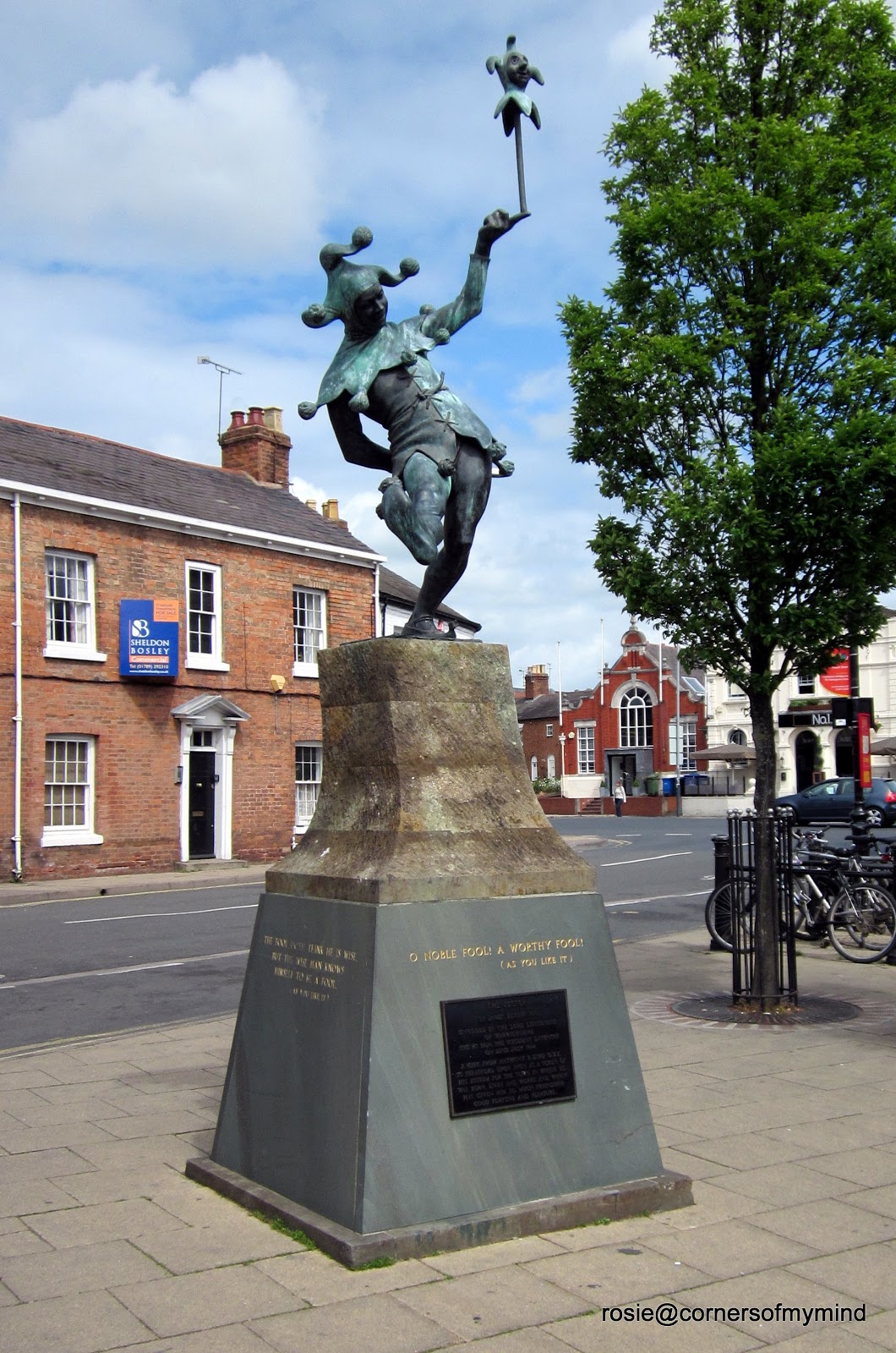
Statue of a Jester by James Butler at the top of Henley Street

Shakespeare's Birthplace - from the front.......

and from the back - I peered through the gates to take this photo as we didn't go inside.

It was time to move on as we were going to visit Baddesley Clinton before we began our journey home, I'll be back with photos from there later this week.