Thursday, April 19, 2018

Over the fields

Where are we?  

 You might think we were out in the countryside walking across hills under leaden skies

 The ground is wet and muddy and you definitely need waterproof boots or wellies.

 The area I've photographed is called Berry Hill Fields and is no more than ten minutes walk from where we live. 

 It's an area of  fields, a green oasis in between all the housing of Fenton and Longton two of the six towns which make up the city of Stoke-on-Trent.  Here people can walk, exercise, picnic, walk dogs, ride horses and spot wildlife.  Many birds spotted here you would usually only associate with more rural areas.

 As we walked we saw a heron fly above us, buzzards and kestrels were also spotted as well as skylarks. Recently, according to a birding website a ring ouzel, wheatears and lesser whitethroat have been spotted. There are small ponds housing rare newts and also many species of insects.  Fox, badger, rabbit and hare live here too.

 The bottom area of the fields has been turned into a nature reserve and a friends group was formed quite a few years ago now.  Here is a - link - to their website to find out more.

 Recently it has come to the attention of the residents of the surrounding housing estates that this area is now under threat from a housing developer.  There have been several meetings and now an action group has been formed to fight the building of houses, shops and access roads on this site when there are more suitable brownfield or old industrial sites with derelict factory buildings within the city that could be used.  More houses are definitely needed but it does need to be affordable housing for both purchase and rental not the kind of housing that is likely to be built. Although any kind of housing and roads would have a huge impact upon the wildlife in this area.

Both the nature reserve and the nearby retirement village could be affected by the development if it goes ahead. We will watch with both concern and  interest to see what  happens over the next few months.

The nature reserve is also the site of a medieval moated farm house known as Lawn Farm.  An archaeological survey discovered the foundations of the farm house

 Wording on the information panel above is:-

In the 13th and 14th centuries activity on Beryyhill fields centred on the moat below you.  Archaeology has shown that here the Lord of the Manor kept a hunting lodge.  Most of Berryhill was covered with the woods of Fenton Park where deer roamed.  Other creatures that ended up of the Lord's table were fish from the ponds formed by damming a small stream and pigeons nesting in a large round dovecote within the moat.  Grain was dried in the outdoor oven but the purpose of the large central building is as yet unknown, perhaps this was where the Lord of Manor entertained his guests.

 
Above is what remains of the moat today, the foundations of the buildings found by the dig have been covered over.

The winding path above leads up the hill to the four black painted pit wheels which stand close to  the site of the old Mossfield Colliery.

This is a memorial to the sixty four miners who lost their lives in the explosion at the colliery on 16th October 1889. There is another memorial which lists the names of those lost in Longton Cemetery.  There was another explosion at the same colliery on 21st March 1940 when eleven miners were killed and one man severely injured.

All photos were taken over the Easter weekend.

Thursday, April 05, 2018

At last! Some signs of Spring

There have been lots of lovely signs of Spring to spot this week.  We have a pair of long-tailed tits nesting somewhere in the garden and they are regularly visiting the fat balls just outside the conservatory window.  I haven't been able to get a decent photo of them yet as they flitter away so quickly.  We've never had them nest here before and it feels like quite an honour.  We also have a pair of dunnocks and a pair of robins.  Today I heard the blackbird singing as I moved  around the garden on a bit of a tidying spree.  In the herb bed both rosemary and thyme seem to have been defeated by winter so have had to be taken out. Sage, parsley and chives seem to have survived as have the lavender and catmint. The sun felt warm on my back and clothes were flapping and drying slowly in the breeze. The pond seems unusually still with no frogs or frog spawn this year, something else affected by the strange weather of the last couple of months.

On our Tuesday walk we spotted....
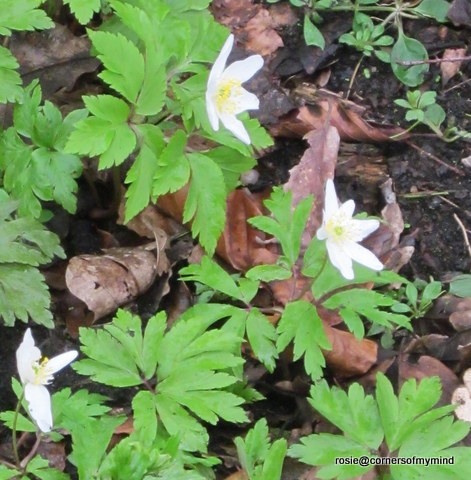
Wood Anemone

I love to see this woodland spring plant with its pretty star like flowers as it spreads like a carpet across the woodland floor. A member of the buttercup family it is also known as windflower, thimbleweed and smell fox. 

We also saw primroses in great profusion.  Such a delicate, beautiful flower.

In the garden the rhubarb is looking good and strong, we'll soon be able to eat the first sweet stems.

As I took photographs of the rhubarb a butterfly landed daintily on its leaves. It was a Comma.

Little pink Bellis flowers lurking by the pond.

Tulips in a pot, I think these are the purple, feathery ones.

Peony shoots looking strong and healthy after we thought we'd lost the plant last year.

Wild Garlic or Ramsons at the top of the garden under the trees, another favourite to see both in the garden and on woodland walks.

 Lungwort or Pulmonaria with its pretty flowers and spotty leaves.

A stray flower we think it is a bluebell but definitely not a native one.  We have a clump of those and they are no where near flowering yet. I don't know where it has come from, it wasn't there last year or if it was it didn't flower.
Edit One - Ellie has pointed out in a comment that this flower is probably a hyacinth and I think perhaps she could be right, looking again at the shape of the flower it does look like a bit like a hyacinth.  Thank you Ellie.

Edit Two - I've been out in the garden this afternoon and the flower has opened so this may help with the identification. I've been 'googling' and it looks a bit like a wild hyacinth also known as a common bluebell native to the Western Isles - details here
How wonderful it should end up in our garden.

Marsh Marigolds in the pond.  I do miss those absent croaking frogs.

Thursday, March 29, 2018

Scavenger Photo Hunt - March

Joining in once again with the Scavenger Photo Hunt organised by
by Kate at 'I live, I love, I craft, I am me' blog. The word prompts for March are:- 
Hole
Making
reading now
black and white
starts with an 'H'
Own choice

Hole - Rabbit hole spotted in the grounds of Beeston Castle, Cheshire, where we visited recently.  We did see a rabbit later on when we took the woodland walk around the castle.  Post about our visit - here.

Making- Paul makes a paper plane from a free downloaded pattern and then tests it outside.

Reading Now - The Sewing Machine by Nathalie Fergie.  I decided to photograph my kindle copy of the book with my Mum's old Singer sewing machine which was made, I found out from its serial number, in 1939 in Clydebank near Glasgow. My Mum would have been twenty three years old when she bought it. The book follows owners of the sewing machine in the title at different times over the last hundred years or so. Talking of generations, I was born when my Mum was thirty four and coincidentally my Mum was born when my Grandma was thirty four. 

Black and White - Swans on the lake at Trentham Gardens, Stoke-on-Trent, Staffordshire.


Starts with an 'H' - load of hay on a waggon driven by a tractor which we followed through Colsterworth and across the flyover which takes you to the other side of the A1.  We were on our way via Colsterworth and Bourne to Spalding in Lincolnshire.

Your own choice - I loved this bright red post box which I saw in the Museum of Iron at Coalbrookdale in the Ironbridge Gorge in Shropshire when we visited the Women of Coalbrookdale exhibition - details here. The post box is called a Penfold postbox after its designer J W Penfold (1828 - 1909).  It is hexagonal in shape and made in cast iron by Cochrane, Grove and Co of Dudley c. 1870.

Follow the link above to find others who are joining in with the Scavenger Photo Hunt this month.

Monday, March 26, 2018

Monday Miscellany

Time for another Monday Miscellany.
Just a few simple things that have made me smile over the last few days.

Seeing the place I used to work when we paid a visit to Spalding in Lincolnshire last week.  The museum now closes on Mondays and Tuesdays so I couldn't go in.  I had a peep through one of the windows and could see some of the displays had changed since my last visit about five years ago.  When I worked there we were open every day but we did house the Tourist Information office as well and we did have a lot of visitors especially in Spring for the Flower Parade and Flower Festivals during what used to be called 'Tulip Time.'

I was intrigued by this old chair that had been used as a planter for Spring flowers.  It looks as if sphagnum moss has been placed where the seat would have been and that it has been planted much like a hanging basket.  Great idea and good recycling of an old chair.

Tea and Ginger cake at the Emma Bridgewater factory shop cafe. No reason to visit, we didn't buy anything, we just like it there as it is bright, warm and welcoming.

Max our very elderly cat has taken his first steps outside now that the weather is warmer.  He hasn't been out since Autumn last year as his health hasn't been good,in fact, I hadn't expected him to see Spring but there he is doing a tour of his garden before heading back inside again.  He will be 22 years old in April.

 Tomato, courgette and bean seedlings are sprouting in their trays in the conservatory.  It will be a while yet before they go out into the greenhouse, especially as cold weather has been predicted to return in the middle of next week.


 I've just finished reading a book by an author I hadn't come across before, set in modern day Amsterdam.  It took a little while to warm to the main characters but in the end I couldn't put it down.

Have any small seemingly inconsequential things made you smile recently?

I'll be back later this week for March's Scavenger Photo Hunt.

Sunday, March 25, 2018

Beeston Castle

A couple of weeks ago we decided to visit Beeston Castle which is near Tarporley in Cheshire.  We had visited before but quite long time ago and passing the signs to the castle on our way up to Chester recently made us want to to visit again.
First things first we sat in the car and drank warm coffee from flasks we'd brought with us, watching others arrive, park and wander into the property via the Victorian Gatehouse.  It was quite windy so hats, scarves and gloves were required before venturing up to the ruins.

Where to go first, Castle, Woodland Walk or Caves?  
We decided to go to the top of the hill first. As we walked up the wind got more and more blustery.  The first section of ruined walls you come to is the outer curtain wall and gatehouse.

We decided as it was windy to head on to the top of the hill just in case it got any worse, a couple of times I felt as if my feet may be lifted off the ground. I'm not a lover of wind and really dislike wearing hats, except perhaps a wide brimmed sun hat in summer, but I was so glad I'd pulled on a woolly hat before we left the car park.

Halfway there, it was quite a trek up to the top with no shelter from what now felt like gales.
We got as far as the modern bridge which takes you through the inner gatehouse and into the inner bailey.


The castle dates from c1220 and was built by Ranulf, Earl of Chester incorporating the banks and ditches of an Iron Age hill fort.  The inner ward has a very rocky base and there is no evidence of any major buildings like a great hall or kitchens.  There are remains of fireplace in what would have been the accommodation area for the constable who looked after the castle on behalf of the owner.  The well, which was first recorded in 1230 , is said to be one of the deepest of any to be found in any castle in England.  It is also said to be the hiding place of Richard II's treasure which legend has it was buried here in 1399.
 
The views from the top of the rocky crag are stunning. Apparently on clear days you can see upwards of thirty miles in all directions and across eight counties.  The castle was seized by Henry III in 1237 and it remained the property of the crown until the 16th century.  During the English Civil War the Royalists took the castle from the Parliamentarians in 1643 by 1644 it became imperative that the Parliamentarian forces regain the castle so in 1644 began the siege.  The Royalists held out until November 1645 before finally surrendering to the Parliamentarian forces after the nearby Battle of Rowton Heath.  There is a small exhibition in the gatehouse where relics of both the Bronze and Iron age can be seen as well as artifacts from the Civil War period of occupation.

Above, several of the features to be spotted in the inner ward of the castle where we had to hold on to each other at times as it felt  we would blow over the walls.

We walked back down the hill to the start of the woodland walk.  This takes you all around the outside of the castle.

It was a lovely walk, sheltered from the wind

The woodland is apparently a haven for birds and mammals.  We did see a rabbit, I make a note of this as it is very rare to see a rabbit nowadays. Up until a few years ago we used to see fields full of bunnies on our walks. 

There were many crows overhead but we didn't see the peregrine falcons mentioned on the website, buzzards were absent too.

At the end of the walk we came across the caves which are according to the leaflet a haven for bats and recently a rare species of bat, the Lesser Horseshoe bat has been found roosting in the caves by members of the Cheshire Bat Group.

The caves are fenced off but you can peer into the mossy,  cobwebby sandstone entrances.

Apparently the caves were caused by the work of stone quarrying in the 18th century. 

We thoroughly enjoyed our visit especially the wonderful views - we spotted the Lovell telescope at Jodrell Bank in the distance - and the woodland walk but it was good to get back to the shelter of the car and to wend our way home again.